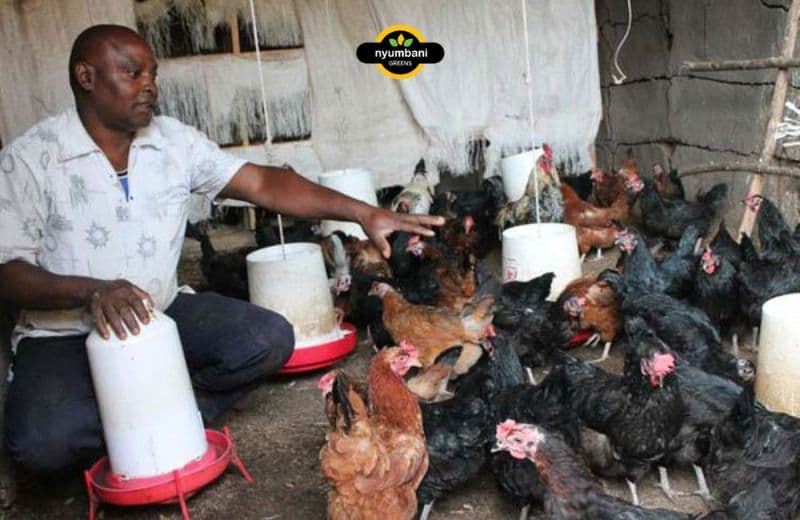
Types of Improved Kienyeji Chicken in Kenya
Kienyeji chicken farming has moved far beyond the slow-growing village bird many Kenyan households grew up with. Today, improved kienyeji breeds give farmers faster growth, higher egg output, and stronger disease resistance, while still keeping the taste and free-range character that kienyeji meat and eggs are known for.
If you are choosing a breed for your farm, or simply curious about what makes a chicken or an egg kienyeji improved, this guide breaks down every major type available in Kenya, how they compare, and what to expect from each one.
What Is an Improved Kienyeji Chicken?
An improved kienyeji chicken is not the same as the traditional free-range bird kept in rural homesteads for generations. It is either a cross between two strong indigenous lines, or a scientifically bred indigenous variety selected for better performance, without introducing full exotic genetics.
The Kenya Agricultural and Livestock Research Organization, commonly known as KALRO, along with Egerton University, has led most of this breeding work in Kenya. Their goal was straightforward. Take the hardiness and taste of the local chicken, then improve its growth rate, egg production, and resistance to common poultry diseases like Newcastle disease and fowl pox.
The result is a bird that matures in four to six months instead of seven to ten, and lays 150 to 280 eggs a year instead of the 40 to 80 eggs a traditional kienyeji hen produces.
Main Types of Improved Kienyeji Chicken
1. KALRO Improved Kienyeji (KARI Improved Kienyeji)
This is the most recognized improved breed in Kenya, developed by KALRO through its Naivasha and Kakamega research centers. It is often still called KARI Improved, a name that comes from the Kenya Agricultural Research Institute, KALRO's predecessor.
Unlike some other improved breeds, this one is not a cross with an exotic bird. Its parent stock was selected purely from indigenous chickens with strong traits, then bred over generations to boost performance. That is why farmers view it as the closest thing to a true "improved" local chicken rather than a hybrid.
The breed has gone through several generations, known as KC1, KC2, and KC3. KC1 and KC2 had black or dark plumage, while KC3 was introduced with brown and white speckled feathers after farmers in Western Kenya asked for a lighter color that better matched buyer preference. All three lines share similar performance.
Key characteristics:
- Matures in four and a half to five months
- Lays between 200 and 280 eggs per year
- Eggs weigh around 55 to 60 grams, heavier than typical kienyeji eggs
- Strong resistance to common poultry diseases
- Performs well on low-cost feed and kitchen scraps
- Mature cocks reach 3 to 3.5 kilograms
This breed suits farmers who want a dual-purpose bird, meaning good returns from both eggs and meat, without depending heavily on commercial feed.
2. Kuroiler Chicken
The Kuroiler originated from Kegg Farms in India and was introduced into East Africa through Uganda around 2010 before spreading into Kenya. It is a cross between an Indian broiler line and a native fowl, developed specifically for smallholder, low-input farming systems.
Kuroilers are known for their ability to forage almost entirely on kitchen waste, vegetable peels, and whatever they find scratching around the compound, which makes them attractive to farmers who cannot afford consistent commercial feed.
- Matures between three and five months
- Lays around 150 to 200 eggs annually
- Cocks can reach 4 to 5 kilograms at maturity
- Thrives on scavenging and low-protein feed
- Well suited to free-range and semi-intensive systems
Kuroilers tend to grow bigger than most other improved kienyeji types, which makes them popular with farmers focused mainly on meat production.
3. Sasso Chicken
Sasso originates from France and was introduced to African markets because of its slow, natural growth pattern that produces firmer, more flavorful meat, closer to what buyers expect from kienyeji. It has a heavy body, long keel, and lightly speckled feathers, with yellow skin that is popular in the local meat market.
- Matures in three and a half to four months for meat purposes
- Lays 150 to 200 eggs a year
- Feeds well on grass, insects, and kitchen leftovers
- Preferred for meat due to its taste and skin color
- Slower-growing compared to Kenbro and Kuroiler
Sasso is often chosen by farmers targeting hotels and butcheries that specifically ask for kienyeji-style chicken with better texture and flavor than a standard broiler.
4. Kenbro Chicken
Kenbro is a Kenyan-developed dual-purpose breed, recognized for its brown body with reddish feather tones and fast growth. It was created to combine quick weight gain with a decent egg-laying rate, giving farmers flexibility depending on market demand.
- Reaches 1.5 kilograms in about three months
- Starts laying at 22 to 24 weeks
- Produces around 200 to 250 eggs annually
- Grows faster than Sasso and Kuroiler
- Performs well in both free-range and semi-intensive setups
Because of its balance between meat and egg output, Kenbro is often the first choice for new farmers testing improved kienyeji farming before scaling up.
5. Rainbow Rooster
The Rainbow Rooster was bred at Indbro Research and Breeding Farms in India and is known for its multi-colored plumage, which gives it a striking, ornamental appearance. Despite the name, it is raised commercially for both meat and limited egg production.
- Cocks can exceed 4.5 kilograms at full maturity
- Lays 160 to 180 eggs a year
- Requires commercial layer feed for best performance
- Grows quickly and reaches market weight in about four months
- Recognized by its bold, mixed feather coloring
Rainbow Roosters are popular with farmers who want a large, visually distinct bird, often for niche or premium meat markets.
6. Dominant Kienyeji Chicken
The Dominant breed originates from the Czech Republic and has been introduced into Kenya's improved kienyeji market as a hardy, disease-resistant option built for backyard and small-scale farming. It comes in several color varieties, which allows farmers to select birds that match specific regional buyer preferences.
- Lays 250 to 300 eggs annually, among the highest of improved kienyeji types
- Matures in about five to six months
- Strong immune resistance, requiring minimal vaccination support
- Available in multiple color lines
Dominant birds are gaining ground with farmers who prioritize egg production over meat yield.
Comparing the Breeds
| Breed | Primary Use | Maturity Period | Eggs Per Year |
|---|---|---|---|
| KALRO Improved (KC1 to KC3) | Dual purpose | 4.5 to 5 months | 200 to 280 |
| Kuroiler | Meat, scavenging | 3 to 5 months | 150 to 200 |
| Sasso | Premium meat | 3.5 to 4 months | 150 to 200 |
| Kenbro | Dual purpose | 3 to 4 months | 200 to 250 |
| Rainbow Rooster | Meat | 4 months | 160 to 180 |
| Dominant | Eggs | 5 to 6 months | 250 to 300 |
How to Choose the Right Breed
The best breed depends on what you are farming for. If your main goal is steady egg income, KALRO Improved or Dominant birds give the highest annual yields. If meat is the priority, Kuroiler and Rainbow Rooster grow into larger birds. For farmers targeting hotels and premium buyers who want authentic kienyeji flavor, Sasso and Kenbro strike a good balance between taste and growth speed.
Feed access also matters. Farmers with limited capital for commercial feed do better with Kuroiler or KALRO Improved, since both perform well on kitchen waste and forage. Breeds like Rainbow Rooster need more consistent commercial feeding to reach their full potential.
If you are looking for genuinely free-range kienyeji eggs from birds raised the traditional way rather than intensive commercial systems, Nyumbani Greens supplies kienyeji eggs sourced from small farms around Nairobi.
Frequently Asked Questions
What is the difference between kienyeji and improved kienyeji chicken?
Traditional kienyeji chickens grow slowly and lay few eggs, usually under 80 a year. Improved kienyeji breeds are selectively bred or crossed to grow faster and lay far more eggs, while keeping most of the taste and hardiness of the local bird.
Which improved kienyeji breed lays the most eggs?
Dominant and KALRO Improved (KC3) birds lead in egg production, with some flocks reaching up to 280 to 300 eggs per year under good management.
Can improved kienyeji chicken survive on free range alone?
Most improved breeds, especially Kuroiler and KALRO Improved, do well on free range and kitchen scraps, though supplementing with some commercial feed improves growth and egg output.
Is Kuroiler the same as kienyeji?
Kuroiler is classified as an improved kienyeji type because it behaves and forages like a local chicken, but it originated from a cross with an Indian broiler line rather than pure indigenous stock.
How long does it take an improved kienyeji chicken to mature?
Most improved breeds reach market weight or point of lay in three and a half to six months, compared to seven to ten months for traditional kienyeji chickens.
"Knowledge is the foundation of sustainable progress. By sharing insights and fostering understanding, we create a better future for agriculture and healthy living."